
When Reading, Writing, Maths, Memory and Coordination Are Hard: Why Learning Difficulties Are More Connected Than They Look
If your child struggles with reading, handwriting, maths, memory or coordination, it can feel like six separate problems, each needing its own fix. But these learning difficulties are more connected than they look. What if the struggles you’re watching your child work so hard through aren’t six problems at all, but one story written across several skills?
Perhaps reading is hard.
Spelling words that they knew yesterday seems impossible today.
Handwriting is slow, messy or exhausting.
Maths facts simply don't seem to stick.
Homework takes far longer than it should.
They lose their things, forget instructions, struggle to organise themselves or have no idea where to begin a task.
Maybe they are also awkward with ball skills, have difficulty learning new movements, struggle to coordinate both sides of their body or seem to work much harder than other children just to keep up.
Reading, writing, mathematics, memory, attention, organisation and movement depend upon multiple systems working together.
So when a child is struggling across several areas, stop looking at each difficulty only in isolation.
Look underneath the skills.
The difficulties may look different however the foundations often overlap.
We often organise children's learning difficulties according to what we see. If a child struggles with reading and spelling, we think about literacy or dyslexia. If handwriting is difficult, we work on handwriting. Some children may eventually be identified with dysgraphia. If maths is the problem, we focus on numbers. Some children may be diagnosed with dyscalculia. If a child is clumsy or finds movement and motor planning difficult, we may hear terms such as dyspraxia or Developmental Coordination Disorder.
Then there are the difficulties that don't fit neatly into one subject at all:
poor working memory
difficulty following multi-step instructions
poor attention and focus
losing belongings
forgetting what needs to be done
difficulty starting tasks
poor organisation
difficulty planning
poor time management
slow processing
difficulty sequencing
struggling to complete homework independently
becoming overwhelmed by multi-step tasks
These are often discussed under executive functioning.
To a parent, however, they may simply look like:
“Why do I have to remind my child five times?”
“Why does homework take us two hours?”
“Why does my child know this one day and forget it the next?”
“Why can't they get themselves organised?”
“Why is everything so much harder than it should be?”
These are important questions.
When several difficulties appear together, we need to look beyond the individual skills and examine the foundations they share.
Learning is a brain-and-body process
A child sitting at a desk may appear to be doing very little physically.
Consider what has to happen for a child to read a paragraph, answer a question and write the response.
The body needs sufficient stability to sit and work.
The head and eyes need to work together.
The eyes need to locate information and move efficiently across a page.
The brain needs to process what is seen and heard.
Information needs to be held in working memory long enough to use it.
The child needs to filter distractions, maintain attention and sequence information.
The two sides of the body need to coordinate.
The hand needs to control the pencil while the rest of the body provides stability.
The child then needs to organise their thoughts, plan a response and execute it.
And all of this needs the nervous system sufficiently regulated for learning.
That is not one skill. It is an extraordinary amount of neurological organisation.
When some of these underlying processes are inefficient, the difficulty becomes visible at the level of reading, handwriting, maths, attention, memory, coordination or homework.
This is why at Neural Connections we talk about:
Foundations before skills.
Not foundations instead of skills. Foundations underneath skills.
Reading and spelling difficulties:
look beyond the words
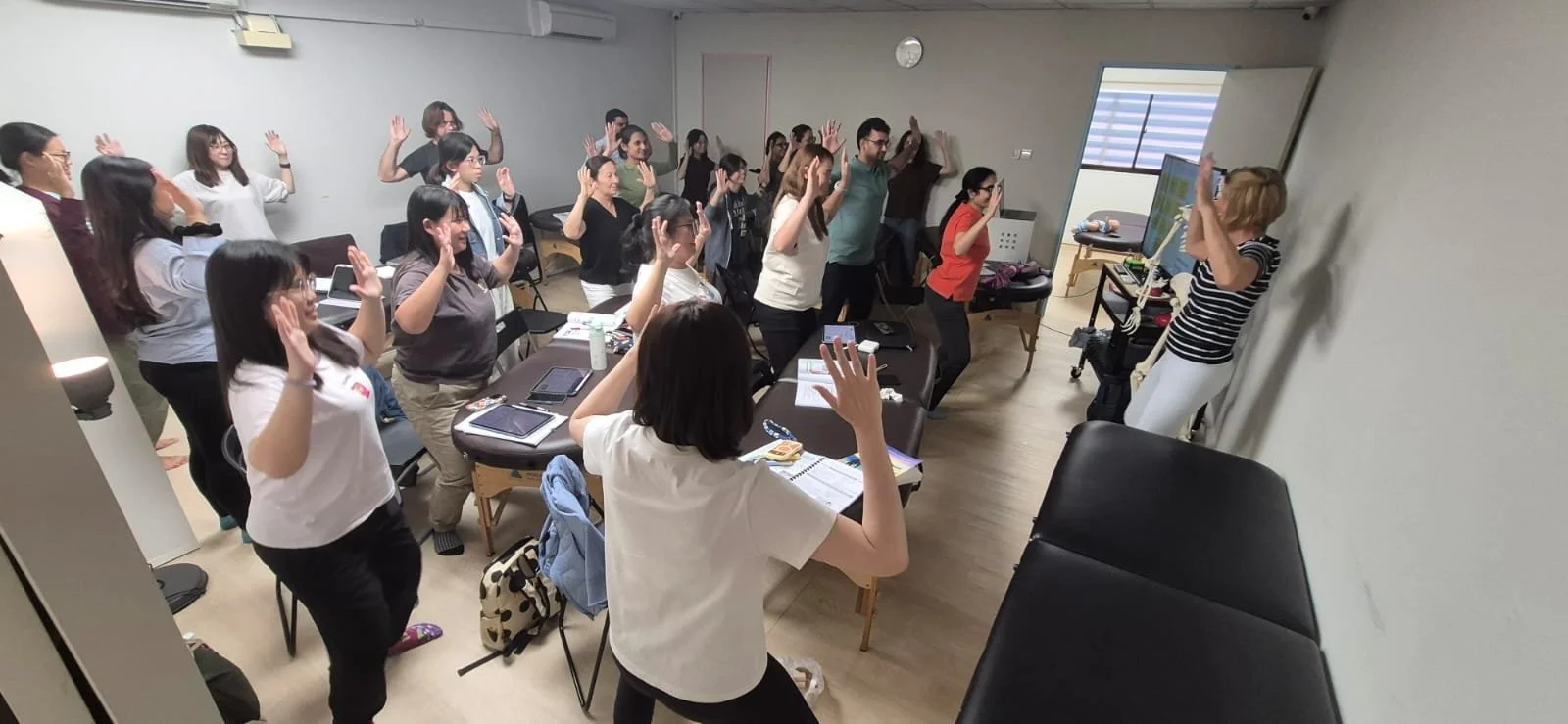
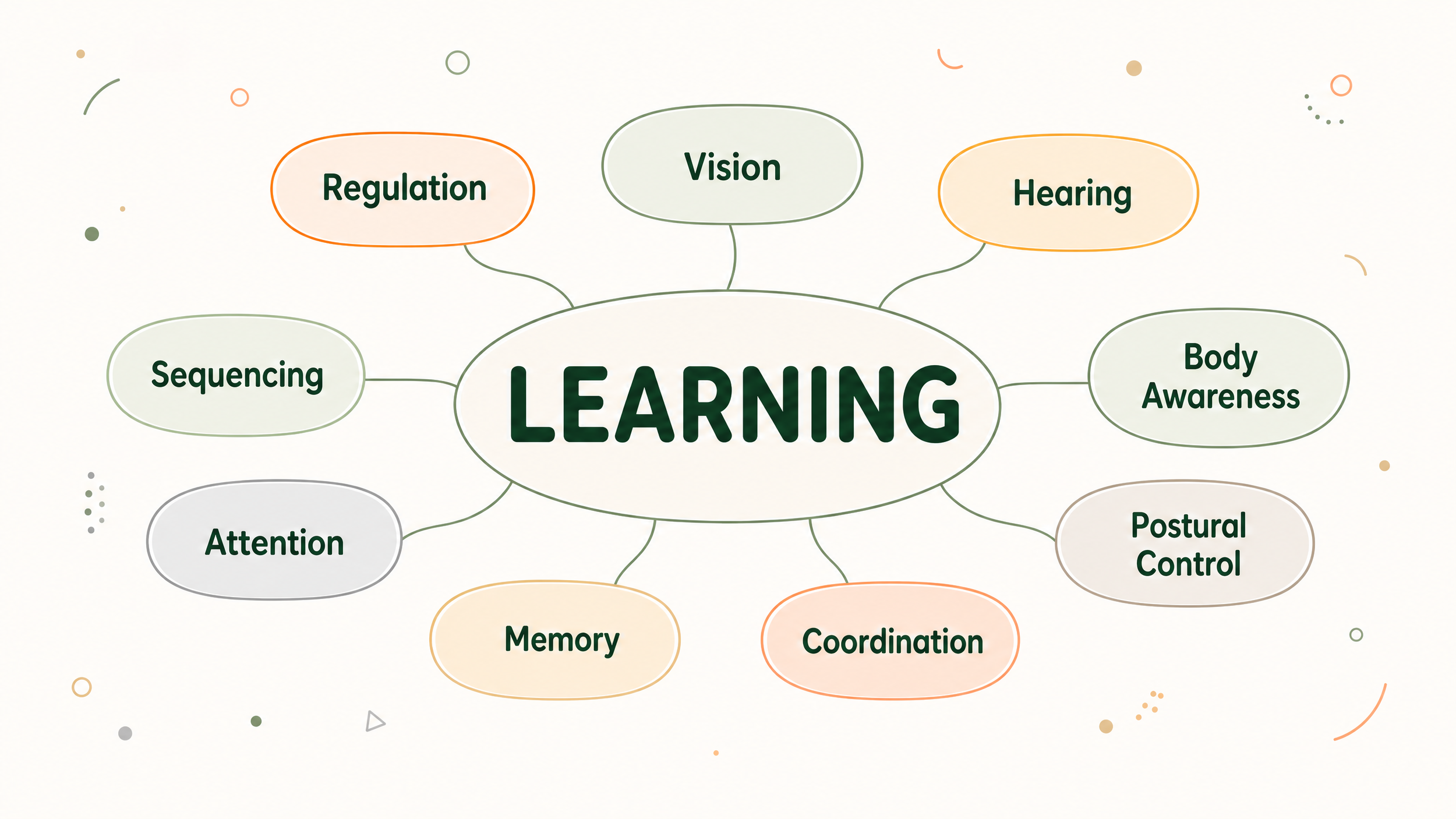
Learning is a whole-body process that involves both the brain and the body, and requires several functions to work together. At Neural Connections, we work on strengthening the brain-body connection.
Dyslexia is the best-known of the four terms and is primarily associated with persistent difficulties with accurate and fluent reading and spelling.
Children with reading difficulties need appropriate evidence-based literacy teaching.
Phonological awareness, phonics, decoding, fluency, vocabulary and comprehension all matter.
But look at the whole child too.
Does your child:
lose their place while reading?
struggle to follow lines of text?
find copying from the board difficult?
confuse sequences?
have difficulty remembering instructions?
struggle to retain letter sounds or spelling patterns?
become exhausted quickly when reading?
find it difficult to sit and concentrate?
struggle to coordinate listening, looking and responding at the same time?
A reading difficulty does not automatically mean dyslexia, and these broader difficulties are not themselves diagnostic of dyslexia.
But when several of these challenges occur together, they give us a reason to look beyond the reading difficulty itself and ask what other foundations may be making learning harder."
At Neural Connections, we focus on offering treatment and protocols to help neurodiverse children regulate their emotions and behaviour better. Schedule a Discovery Call with us today to see if we can help.