Beyond Behaviour: Understanding School Refusal Through the Body - Our Family’s MNRI Journey (Part 2)
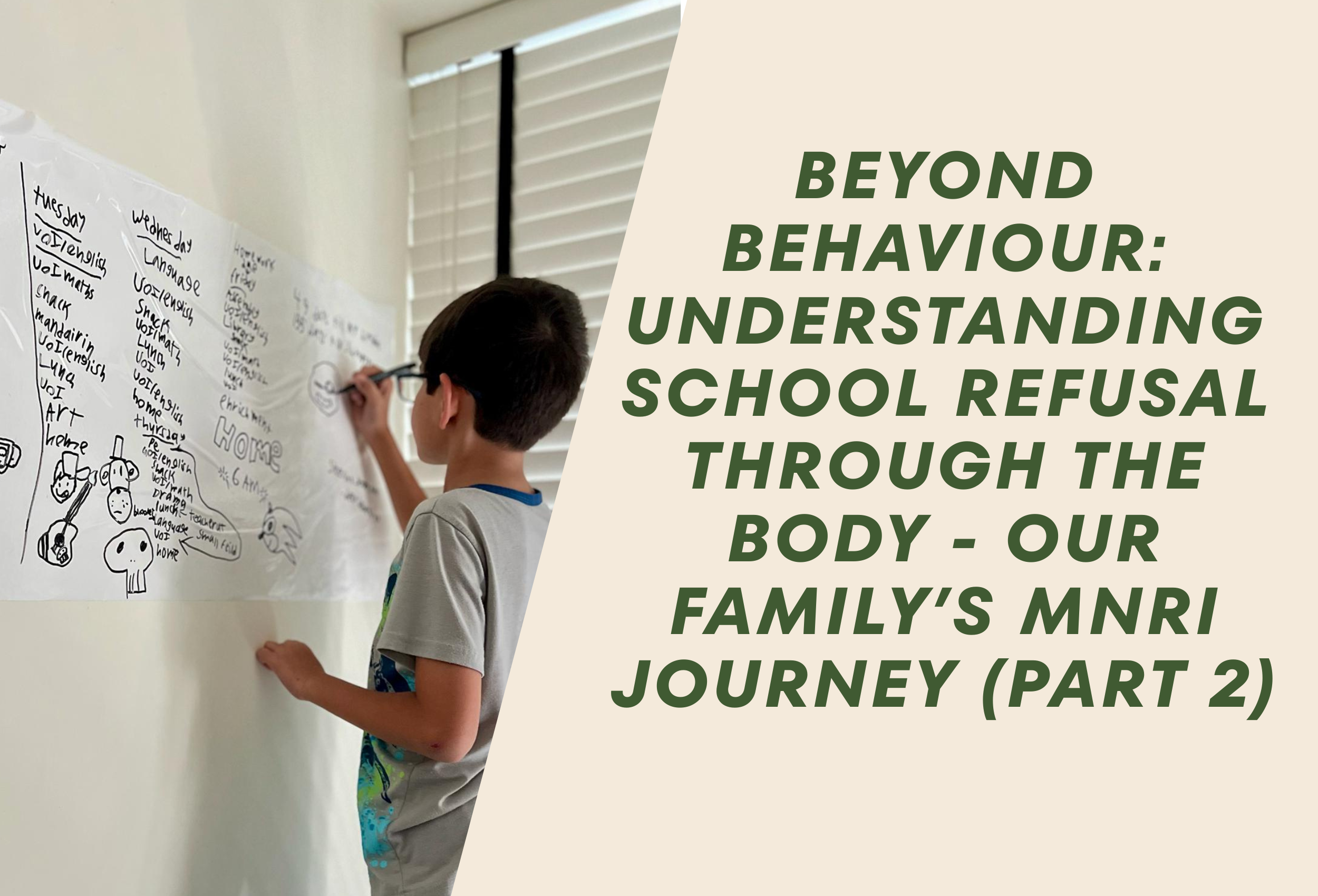
[Photo by Sophia Klopp]
Published: 1 February 2026
School refusal can often be a big challenge for families - with children acting out when they have to get to school. In this month’s blog, our guest writer, Sophia Klopp (@positivedisciplinesg), Certified Parent Educator, shares her family's journey with Neural Connections. After more than three years of an uphill battle of school refusal with her son, Sophia writes how MNRI® and Neural Connections offered her a new lens through which she could finally understand her son's behaviour.
In Part 1, I shared how our family lived with school refusal for more than three years, how the pandemic years shaped my son’s nervous system, and how we began to see his struggles not as defiance or lack of motivation, but as a nervous system that needed more support.
If you haven’t read it yet, you can find Part 1 here: https://www.neuralconnections.co/articles/school-refusal-part1
By the time we started with Neural Connections in April 2025, I was feeling defeated. More than three years of dreading mornings had worn me down, even with all the parenting tools and emotional awareness I had. I wasn’t looking for another strategy, chart, or routine. I needed something that could support him at a deeper level — something that didn’t rely on willpower, motivation, or “trying harder.”
When we went for the initial assessment at Neural Connections, what struck me most was how non-pathologising the process felt. The question wasn’t, “What’s wrong with him?” but “What is his body carrying every day?”
The word that kept coming up was stress.
Hsiao explained that when a child’s stress load is high, school itself can feel unsafe — no matter how kind the teachers are or how capable the child is academically. What my son needed wasn’t motivation. His nervous system needed stress resilience. That reframe softened something in me. Of course I wanted him to be more adaptable. Of course I wanted school to feel less threatening to his body.
In May 2025, I attended my first MNRI Parent Workshop. I remember walking in thinking it might feel a bit like reflexology — pressure points, maybe? What I didn’t expect was how clearly the reflexes connected to the challenges parents talk about all the time: listening, focus, emotional regulation, confidence, impulse control.
I learned how unintegrated reflexes like Moro and Fear Paralysis can make a child hyper-alert or shut down under stress — so a teacher’s voice or a noisy classroom can send the body straight into survival mode. I also learned how reflexes such as ATNR and STNR affect posture, hand control, crossing the midline, and the ability to move between near and far tasks — like copying from the board to paper. Writing wasn’t just “hard” for him; it demanded far more effort than it should have.
What MNRI at home really looked like
I want to be honest here. Bringing MNRI into daily life initially felt like another thing to squeeze into our already very busy family life.
I’m a part-time work-from-home parent with three children and no helper. Limited capacity is real. What helped was not trying to do everything perfectly. Instead, I found ways, based on Hsiao’s suggestions, to weave MNRI into what we were already doing.
We practiced after bedtime stories. I’d wake him gently in the morning with a short regulating exercise. I worked on his hands while we were travelling. We never did it during meltdowns. I intentionally kept it short and calm.
There was also a very clear pattern I couldn’t ignore: when I stopped doing MNRI for about a month, the school refusal and emotional dysregulation crept back in. When we restarted, things eased again.
Because we had learned many reflexes, Hsiao encouraged us to practise the ones we felt most confident doing at home, rather than the more technical ones best done in sessions. A couple of reflexes, a few times a week, was enough to begin. She also reassured me that it was okay to take breaks — just to make sure we returned to it.
The changes were gradual - but real
The shifts didn’t happen overnight. Mornings slowly became less explosive. His body looked less braced. Transitions became easier to recover from. Handwriting was still challenging, but it felt less overwhelming to him.
In July 2025, during the second MNRI Parent Workshop, we learned more hands-on work related to emotional regulation, rigid thinking (YES!), core strength, and fine motor coordination. It helped me see how interconnected everything was. What we often label as “behaviour” really is just the most visible layer. Underneath, the body is constantly trying to cope with stress.
Practicing MNRI together also became a form of connection. As his body felt more stable, his brain had more capacity. Mornings no longer felt impossible. He started doing parts of his routine independently — instead of me feeling like I was dressing a sack of potatoes before school.
By October 2025, we moved into fortnightly MNRI sessions at Neural Connections. The work went deeper than what I could offer at home. I noticed more endurance after school and fewer emotional explosions in the evenings.
A big “aha” moment
One of the biggest moments for me came during these regular sessions.
For as long as I can remember, my son disliked getting his face wet during bathing and avoided swimming altogether. Water felt overwhelming to him. During a session focused on the Moro Embrace Reflex, the team noticed something subtle: when he needed to focus or exert effort, he tended to hold his breath. Breathing out fully was hard for him.
Hsiao explained that the Moro reflex is closely linked to a baby’s first breath — helping open the airway and support the transition into the world. That explanation unlocked a memory I hadn’t revisited in years. When he was born, he took longer than expected to take his first breath. Long enough for us, as parents, to worry. He did breathe eventually — but hearing that connection was eye-opening.
At home, we made breathing playful rather than instructional. Smelling essential oils, herbs, or baked goods. Practising “bunny breathing.” Taking deep breaths and roaring like lions. It wasn’t about correcting him. It was about giving his body safe, positive experiences with breath.
When others started noticing the difference
By November, the school began noticing changes too. They commented that he seemed more confident and independent. One staff member said the “deer in headlights” look was gone.
I couldn’t help but think of the work we had done around stress, fear paralysis, and the Moro reflex — how supporting those reflexes helped his nervous system move out of survival mode.
My husband, who used to be deeply triggered by our son’s emotional explosions, was amazed by how much more regulated and open to transitions he had become. At one point he said, half-joking, that he probably needed MNRI himself as a child. I told him, “If you’d like, I can give you MNRI,” which earned me a ‘side-eye’ and a reluctant laugh.
Our biggest win so far
By January 2026 — after about nine months of mostly consistent MNRI work, alongside Positive Discipline strategies grounded in connection and collaboration — I saw something that captured the shift for me.
I walked into his room and found him writing his own school schedule on a whiteboard he had mounted himself. No prompting. No reminders. Then I noticed he had written “MNRI” under his sleep strategies for when he has trouble sleeping.
This was a child who once avoided school and resisted writing whenever possible. Seeing him initiate this on his own felt like a clear marker of progress — not because he was “fixed,” but because his body had more capacity.
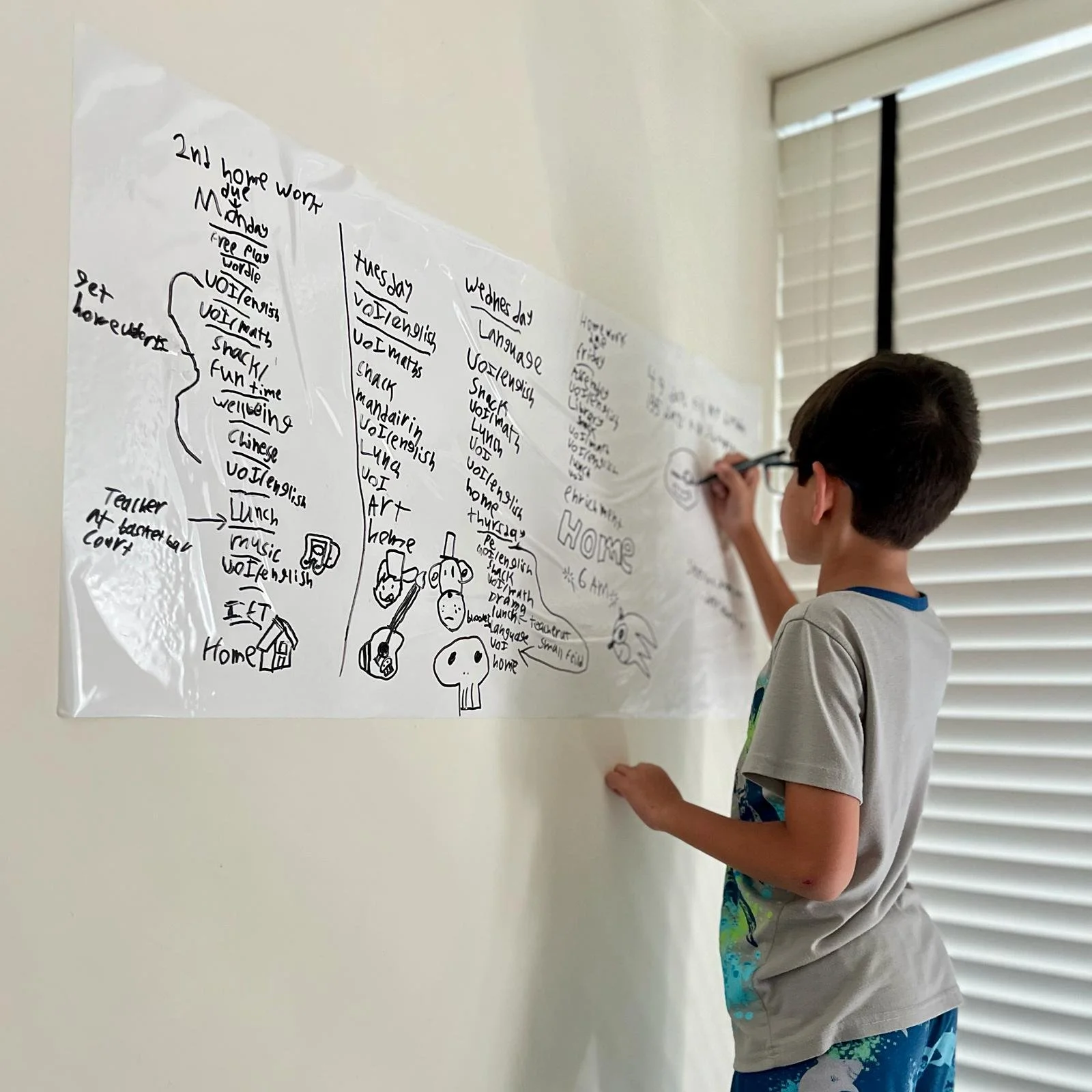
Unprompted. Self-initiated. My 9-year-old with more capacity to plan, organise, and engage. [Photo by Sophia Klopp]
Where we are now
Today, our mornings look very different. He wakes up willingly, gets ready independently, and goes to school without dread. There are still hard days — but they are fewer, and recovery is quicker.
MNRI didn’t fix my child. It helped his body feel safer. And it changed me too. I no longer wake up bracing for battle. I can plan my day without anxiety. And when mornings are hard, I ask a different question now: What does his nervous system need today? Which quick MNRI exercise could help?
School refusal isn’t always about school. It isn’t always about motivation or stubbornness. Sometimes, it’s about a body that has been in survival mode for too long.
You can’t talk a nervous system into feeling safe — but you can support it. The only question in my head now is, “Why didn’t we start this sooner?”
About Sophia Klopp
Sophia’s family started their journey with Neural Connections in April 2025. She is a mother of three (19, 14, and 9), Certified Positive Discipline Parent Educator, Trauma-Informed Facilitator, and Co-Director of Chapter Zero Singapore. Sophia shares practical strategies and Mindful Communication techniques to help parents, caregivers, and educators build respectful, authentic connections with children.
To learn more about Positive Discipline strategies, follow Positive Discipline Singapore on Facebook and Instagram at @positivedisciplineSG. You can also follow Sophia’s respectful parenting journey at @betheircalm on Instagram. You can also learn more about Chapter Zero Singapore and its trauma-informed, neuro-affirming work in compassionate communication, play, The Mindful Educator, and The Mindful Caregiver at https://www.chapterzero.org/.
At Neural Connections, we focus on offering treatment and protocols to help neurodiverse children regulate their emotions and behaviour better. Schedule a Discovery Call with us today to see if we can help.